A junk silver value calculator prices pre-1965 US dimes, quarters, and half dollars at live melt. Each $1 of face amount in 90% coins holds roughly 0.715 troy ounces of pure metal. The core formula: face amount x 0.715 x current spot price per ounce. At a $30 spot, a $10 roll of Mercury dimes works out to 10 x 0.715 x 30 = $214.50 of melt. This page covers the eligible coins, exact weights, step-by-step math, a worked example, and the premiums a dealer will actually quote.
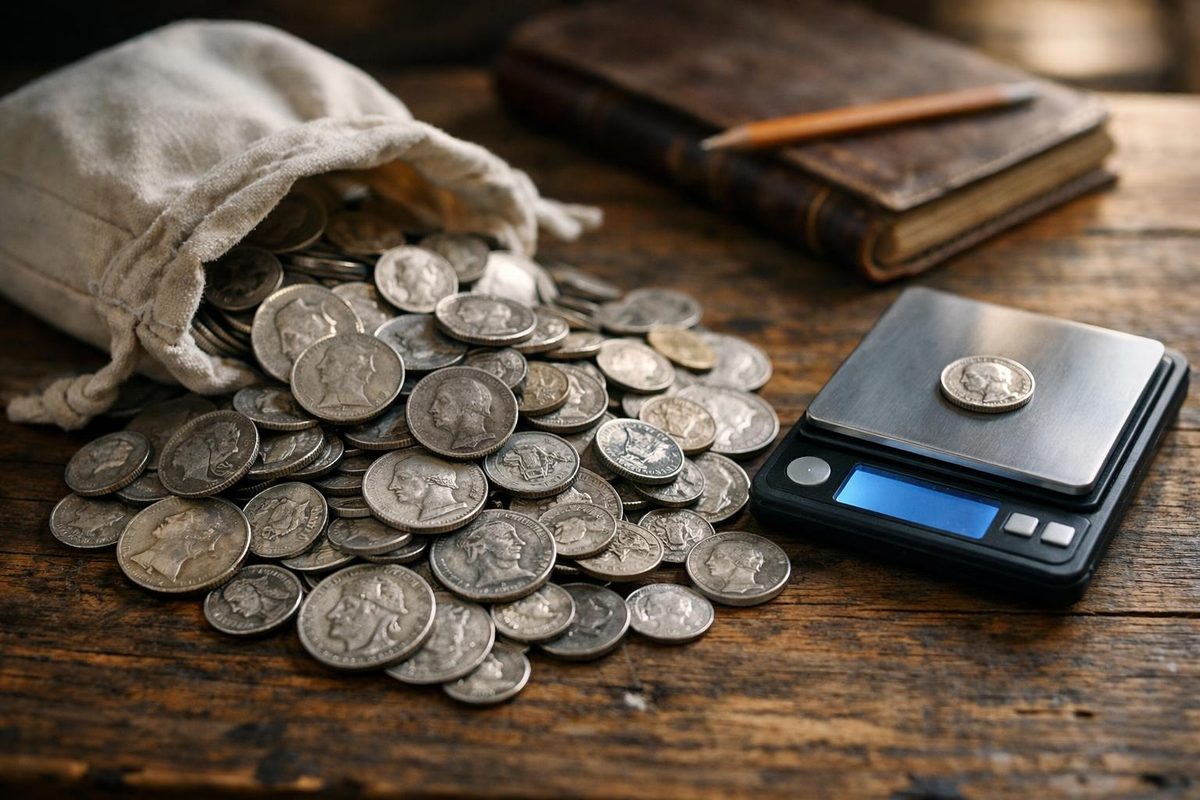
What counts as junk
“Junk” is a trade nickname, not a quality grade. It describes common-date circulated coinage that trades at or near melt because it carries no numismatic premium. The anchor group is dimes, quarters, and halves struck in 1964 or earlier, which were 90% Ag and 10% copper. After the Coinage Act of 1965, dimes and quarters went copper-nickel clad. Halves dropped to 40% Ag from 1965 through 1970, then clad in 1971. Morgan and Peace dollars are 90% too, but they usually sell numismatically.
Junk Silver Value Calculator
Price pre-1965 US dimes, quarters, and half dollars at live melt value.
Melt value uses face amount x 0.715 x spot for 90% coins, plus 0.14795 oz per 40% Kennedy and 0.05626 oz per war nickel. Estimates exclude numismatic premiums on key dates and condition. Morgan and Peace dollars usually trade above melt and are priced on our main silver calculator. Always confirm with a live dealer quote before selling.
90% coin list
- Mercury dime (1916-1945)
- Roosevelt dime (1946-1964)
- Washington quarter (1932-1964)
- Walking Liberty half (1916-1947)
- Franklin half (1948-1963)
- Kennedy half (1964 only)
- Morgan and Peace dollars (pre-1936), usually priced as numismatic
Kennedy halves 1965-1970: the 40% window
Kennedy halves from 1965 through 1970 are a special case. The US Mint cut them to 40% Ag in a silver-clad sandwich rather than going straight to copper-nickel. Each 1965-1970 Kennedy holds 0.14795 troy oz. Stackers call these “40 percenters,” and most bags separate them from the 90% pile. A 1964 Kennedy, by contrast, is full 90% and belongs with the pre-1965 group.
Silver content per coin
| Coin | Years | Composition | Ag per coin (troy oz) |
|---|---|---|---|
| Mercury / Roosevelt dime | 1916-1964 | 90% | 0.07234 |
| Washington quarter | 1932-1964 | 90% | 0.18084 |
| Walking Liberty / Franklin / Kennedy half | 1916-1964 | 90% | 0.36169 |
| Kennedy half | 1965-1970 | 40% | 0.14795 |
| Morgan / Peace dollar | 1878-1935 | 90% | 0.77344 |
| Jefferson “war nickel” | 1942-1945 | 35% | 0.05626 |
Pure metal per $1 face amount
| Face amount (90% coins) | Pure Ag (troy oz) |
|---|---|
| $1.00 | 0.715 |
| $5.00 | 3.575 |
| $10.00 | 7.150 |
| $100.00 | 71.500 |
How the math works
- Sort coins by composition: 90%, 40% Kennedy, 35% war nickel.
- Tally face amount per group. Ten dimes = $1.00, four quarters = $1.00.
- Multiply 90% face amount by 0.715 for pure troy ounces.
- Add 40% Kennedys at 0.14795 oz each and war nickels at 0.05626 oz.
- Multiply total ounces by today’s spot per ounce.
- Deduct a 2% to 5% bid spread for a realistic sell estimate.
Worked example
You hold 100 Roosevelt dimes dated 1964 or earlier. Face amount = $10. Pure content = 10 x 0.715 = 7.15 oz. At $30 spot, melt is 7.15 x 30 = $214.50. A dealer paying 97% of melt would bid roughly $208. Buying the same bag retail, expect a 5% to 15% premium, so $225 to $247 is realistic.
Buying vs selling premiums
Spot is a reference, not a transaction price. Dealers quote a bid (what they pay) and an ask (what they charge). Retail premiums on 90% junk coinage run 5% to 20% over spot, with tighter spreads on $1,000 face-amount bags. Sell-side bids sit a few points under. Shop multiple dealers and compare dollars per ounce, not percentages.
Common scams
- Plated replicas weigh far less than genuine 90% pieces. A real Roosevelt dime weighs 2.5 grams.
- Clad coins sold as silver. A 1965 or later dime shows a copper edge on the rim.
- Altered dates. Counterfeiters re-strike a 1965 to read 1964. Check weight and edge color.
- “Collector grade” markup on worn common dates like a 1950 Roosevelt. That’s junk, not a rarity.
FAQ
How do you calculate the worth of junk coinage?
Multiply total face amount of pre-1965 90% coins by 0.715 for troy ounces, then multiply by today’s spot. Add 40% Kennedys at 0.14795 oz each.
What is junk coinage worth today?
It tracks spot. At $30 per ounce, $1 face of 90% coins holds about $21.45 of metal before dealer premiums.
Is it worth buying?
Yes for stackers. It offers recognizable, divisible silver at low premiums over spot without bullion-coin markups.
Are these calculators accurate?
Accurate for melt when coin counts are correct and the spot feed is live. They do not reflect dealer bid-ask spreads or numismatic premiums on key dates.
Is this tool free?
Yes. Most online tools, including ours, are free. You only need coin counts and a current spot quote.
Run your stack through the junk silver value calculator above, cross-check the total against a dealer quote, and remember: face amount x 0.715 x spot is the anchor every offer works from. For broader US coinage weights, see our USA silver coin calculator, the Morgan silver dollar page, the troy ounce explainer, and the precious metals glossary. For mint data, the US Mint coin specifications page is authoritative, and Coin World covers ongoing market moves.