You can tell if gold is real by running five quick checks at home: hold a magnet near the piece, inspect it for a karat stamp, rub it on unglazed ceramic, measure density by water displacement, and apply a drop of nitric acid to a tiny scratch. Real gold does not stick to magnets and has a density of 19.3 g/cm3 when pure.
This guide walks through each test from safest to most invasive. If one comes back suspicious, run a second before you draw a conclusion.
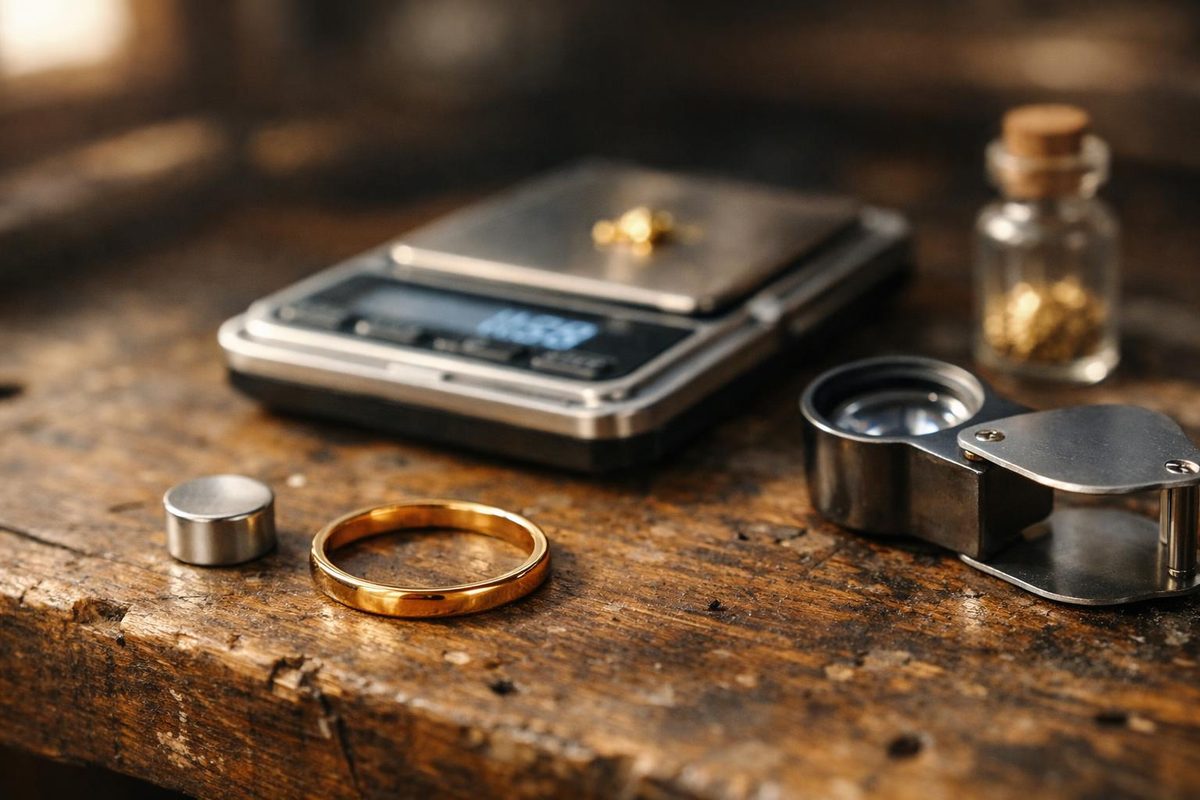
What “real gold” actually means
Pure 24k contains 99.9% Au. Most jewelry is alloyed with copper, silver, zinc, or nickel for strength. The karat stamp tells you how much is actual precious metal:
- 375 = 9k (37.5%)
- 417 = 10k (41.7%)
- 585 = 14k (58.5%)
- 750 = 18k (75.0%)
- 916 = 22k (91.6%)
- 999 = 24k (99.9%)
A piece stamped 10k is still genuine, just alloyed. Plated items stamped “GP,” “GF,” “HGE,” or “RGP” are mostly base metals with a thin coating.
Test 1: Neodymium pull
Pure gold is diamagnetic and will not cling to a strong neodymium bar (available at any hardware store).
- Place the item on a flat, non-metallic surface.
- Hover the bar directly above it.
- Slowly lift. If the piece follows, it contains iron, steel, or nickel filler.
Limitation: a plated piece with a brass or copper core will also ignore the pull, so passing does not prove purity.
Test 2: Read the hallmark
Legitimate pieces carry a tiny stamp. Look inside the ring band, on the clasp, or on the reverse of a pendant. A 10x loupe helps.
Authentic hallmarks pair a fineness number with a maker’s mark and an assay symbol. UK pieces show an anchor (Birmingham) or leopard (London). Indian BIS hallmarks include a six-digit HUID you can verify on the BIS Care app. Missing stamp is not automatic proof of fakery, since old or handcrafted items are often unmarked. Missing stamp plus any other red flag means keep testing.
Test 3: Ceramic streak and skin tests
Drag the edge of the piece across unglazed ceramic. Authentic metal leaves a thin yellow streak. Pyrite and brass leave a black or dark green streak.
The skin test is cruder. Rub the piece on a clean spot on your wrist for 30 seconds. If it leaves a green, grey, or black mark, the alloy contains copper or silver reacting with skin oils, meaning it is plated or very low karat.
Test 4: Density (water displacement)
The most rigorous at-home check. You need a kitchen scale accurate to 0.01 g and a graduated cylinder.
- Weigh the piece dry.
- Fill the cylinder partway with water and record the level.
- Submerge the piece (tie with fine thread so it hangs free). Record the new level.
- Subtract old from new = displaced volume in mL (= cm3).
- Divide weight by volume. That is your density.
Pure gold = 19.3 g/cm3. Expected by karat:
| Purity | Density (g/cm3) |
|---|---|
| 24k | 19.3 |
| 22k | 17.7 to 17.8 |
| 18k yellow | 15.2 to 15.9 |
| 14k yellow | 12.9 to 14.6 |
| 10k yellow | 11.5 to 12.7 |
| Brass (common fake) | 8.4 to 8.7 |
| Tungsten (rare fake) | 19.25 |
Tungsten is the one cheap metal that matches 19.3 within 0.5%, which is why fraudsters drill out bars and pour tungsten in. For jewelry, density alone is a strong indicator. Our jewelry value calculator uses these figures to estimate scrap value.
Test 5: Nitric acid
Acid kits sell for under $25 with bottles labeled 10k, 14k, 18k, and 22k. Each bottle will not dissolve gold at that karat or higher.
- Find a hidden spot and make a tiny scratch with the black stone.
- Put one drop of 14k acid on the scratch.
- Wait 30 seconds. If the streak dissolves or turns milky green, the piece is below 14k or plated. If it stays colored, test up with 18k then 22k.
Wear gloves, work near a fan, neutralize spills with baking soda.
Test 6: Electronic testers
Handheld probes like the GoldXpert read conductivity and return a karat estimate in seconds. Entry units run $100 to $250. XRF guns cost thousands but detect plating instantly. They struggle with very thin chains under 0.5 mm.
What counterfeits typically look like
- Brass dupes: warm yellow but too light. About 8.5 g/cm3 vs 15 to 19 for genuine.
- Gold-plated tungsten bars: correct density, but a drill check reveals the core.
- “HGE” chains: heavy electroplate, about 0.025 mm thick. Wears off in under 2 years.
- “925” stamp: that is sterling silver with gold wash, not gold.
If the price was 40% under spot, assume fake. Check benchmarks with our USA gold calculator or the UK gold calculator.
When to get professional verification
Home tests give high confidence for most jewelry. Use a pro when:
- The piece is worth over $1,000.
- Density lands between two karat grades.
- You suspect tungsten core in a bar.
- You need a written appraisal for insurance.
An appraiser with an XRF analyzer confirms purity in a minute. Expect $30 to $75. Price-check with our precious metals glossary. For bullion standards, see the World Gold Council.
Quick comparison of at-home tests
| Test | Speed | Cost | Accuracy | Damage risk |
|---|---|---|---|---|
| Magnet pull | 10 sec | $5 | Low | None |
| Hallmark check | 1 min | $10 loupe | Medium | None |
| Ceramic streak | 30 sec | $0 | Medium | Tiny scratch |
| Skin rub | 1 min | $0 | Low | None |
| Density | 5 min | $15 scale | High | None |
| Acid | 3 min | $25 kit | High | Small scratch |
| Electronic | 10 sec | $100+ | High | None |
Start with the pull test, read the hallmark, then measure density. Those three cost under $20 and catch most fakes. If you want to learn how to tell if gold is real without doubt, pair density with an acid kit and you will match what jewelers do behind the counter.
Frequently asked questions
How can you test for authenticity at home?
The fastest checks are the neodymium pull, the hallmark inspection, and water displacement for density. Authentic pieces are non-magnetic, stamped with fineness codes like 585 or 750, and weigh 19.3 g/cm3 when pure. Running all three takes under 10 minutes.
What are the signs of a counterfeit piece?
Discoloration on skin, attraction to neodymium, a dark streak on ceramic, density below 10 g/cm3, and stamps like “GP,” “GF,” or “HGE” are classic signs. A piece that feels too light for its size is almost always a brass or aluminum knockoff.
How can I check instantly?
A neodymium pull test plus a 10x loupe for the hallmark gives an instant read and catches about 80% of counterfeits. Confirm with density or acid before you pay.
Can vinegar detect fake pieces?
Vinegar is unreliable. Many plated or low-karat items resist it long enough to pass a short dip. Use nitric acid from a proper kit instead.
How do jewelers run the check?
They run an acid test on a scratch plate, then confirm with an electronic meter or XRF analyzer for higher-value pieces. The acid stone plus an 18k bottle takes about 90 seconds.
Does authentic metal attract to neodymium?
No. Pure Au is diamagnetic. If your piece jumps toward a neodymium bar, it contains iron, steel, or nickel filler, so it is plated or fake.