Short version on gold filled vs gold plated: filled pieces carry a real, bonded layer of karat metal that’s at least 1/20 (5%) of total weight. Plated pieces carry a micron-thin electroplated skin, usually well under 0.5% by weight. That one gap drives everything else: durability, tarnish, skin reactions, and whether a refiner will call you back.
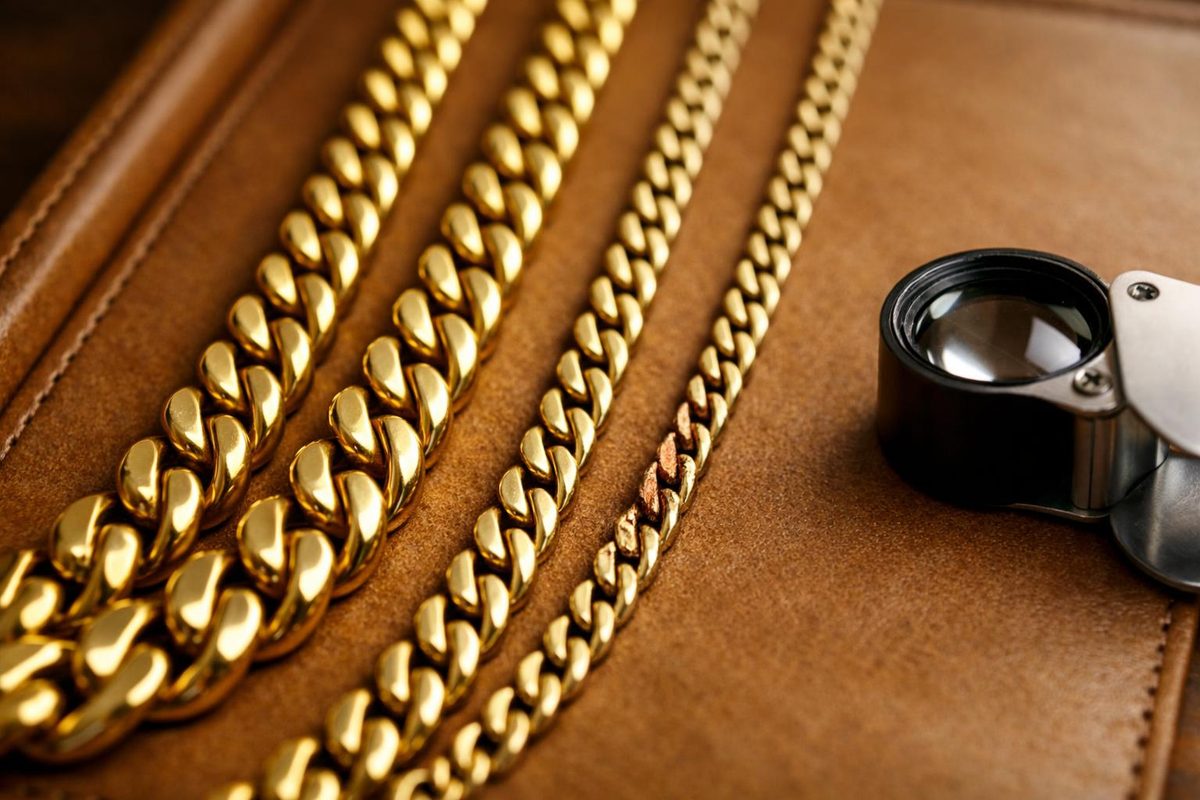
Got a drawer of old chains and want to know which ones have melt value? Here’s the rundown.
The One-Paragraph Answer
Gold-filled jewelry is made by mechanically bonding a thick sheet of karat metal (usually 12K or 14K) to a brass core under heat and pressure. By U.S. FTC rule, that outer layer must be at least 1/20 of the item’s weight. Plated pieces use electroplating to deposit a very thin skin, often 0.175 to 2.5 microns thick, onto base metal. Plating wears away. The fill does not, at least not on any normal human timeline.
At a Glance
| Feature | Filled | Plated |
|---|---|---|
| Content by weight | At least 5% (1/20) | 0.05% to 0.5% |
| Layer thickness | 15 to 40 microns | 0.175 to 2.5 microns |
| Bonding method | Heat and pressure | Electroplating |
| Common hallmarks | GF, 1/20 12K GF, 14/20 | GP, GEP, HGE, RGP, HGP |
| Daily wear lifespan | 10 to 30 years | 6 months to 2 years |
| Typical pieces | Chains, earrings, bangles | Fashion rings, watches |
| Melt value recovery | Possible in bulk | Essentially zero |
The US FTC Rules
The Federal Trade Commission’s Jewelry Guides set the legal floor. Here’s what separates the categories:
- Gold-filled: Layer is at least 1/20 of total weight, bonded mechanically, minimum 10K. A “1/20 14K GF” stamp means the layer is 1/20 by weight at 14 karat.
- Rolled gold plate (RGP): Same sheet-bonding process, but the layer is less than 1/20 by weight.
- Gold electroplated (GEP, GP, HGE): Electrochemically deposited. Sellers can label a piece “plated” at just 0.175 microns. “Heavy gold electroplate” (HGE) requires at least 2.5 microns.
- Vermeil: Electroplated (2.5 microns minimum) over sterling silver. Better than standard plate because the base has its own value.
Anything sold as “gold tone” or “gold color” has no metal requirement. That’s paint or lacquer over base metal.
Reading the Hallmark
Hallmarks tell you almost everything. Flip the piece, grab a loupe, and check near the clasp, bail, or inner band:
- GF or 14/20: filled. Real content.
- 1/20 12K GF: 1/20 by weight, 12 karat layer.
- RGP: rolled plate. Thinner than GF.
- GP, GEP, HGE, HGP: electroplated. Thin layer.
- 925 stamped “vermeil”: plated over sterling.
- No stamp at all: assume plate or costume until proven otherwise.
For a broader walkthrough of jewelry stamps, see our hallmarks guide.
How Much Is Actually In There?
Say you have a 10 gram chain marked 1/20 14K GF:
- Total weight: 10 g.
- Layer weight: 10 ÷ 20 = 0.5 g of 14K.
- Pure content: 0.5 × (14/24) = about 0.29 g fine.
- At a spot price of $2,400/oz, that’s roughly $22.40 in pure content.
The same 10 gram chain, electroplated at 1 micron? Under $1 of fine metal. Refiners won’t touch it unless you’re bringing in pounds of scrap.
Run your own numbers with our USA calculator, and see the troy ounce explainer for weight conversions.
Recovery Value
Blunt truth about cashing in:
- GF: Worth refining in bulk. A kilo of mixed scrap yields 30 to 50 grams of recoverable fine metal. Individual pieces? Not really. Refiners want 1+ pound minimums and take a processing cut.
- Plated: Almost never worth refining. Content is measured in milligrams per piece. Industrial scrappers handle it at scale with chemicals you shouldn’t have at home.
- Vermeil: The outer layer is negligible, but the sterling base has silver melt value. Price it as silver scrap.
How to Test at Home
- Magnet test: Use a strong neodymium magnet. If the piece jumps, the core is steel or iron, so it’s plate at best.
- Visual wear check: Look at high-contact spots (clasp, inside of a ring). Plate shows silver, copper, or brass color peeking through. Filled almost never does.
- Density weigh: Weigh the piece, then submerged in water. Solid karat and filled land in different density zones than plated base metal. Method: how to tell if gold is real.
- Acid test: A 14K kit tells you what the surface is. On plate, filing through first exposes brass underneath.
- Loupe and hallmark: 10x loupe. Find the stamp. It tells you more than any chemical test.
Common Scams
The resale market is full of tricks:
- Listings labeled “gold” that turn out to be HGE or GP once you get the piece.
- “14K overlay” sounds like fill but is often just thicker plate.
- Fake GF stamps on pieces that test as brass all the way through.
- Bullion-style bars marked “clad” or “layered.” These are plate, not solid.
What to Do With Pieces
- Wear or keep: Good GF pieces last decades and are genuinely hypoallergenic for most folks.
- Sell as-is: GF stock sells well on resale platforms. Plate sells mostly for the design, not the metal.
- Scrap in bulk: Shoebox of GF scrap? A reputable refiner will quote a buyback based on assay. Get two or three quotes and compare.
FAQ
Which is worth more, filled or plated?
GF, by roughly 10 to 100 times by metal content for pieces of the same size. Plate is priced for design, not the metal.
Does gold-filled tarnish?
It resists tarnish and doesn’t wear through under normal use because the layer is tens of microns thick. Plate tarnishes and rubs off because the layer is a fraction of a micron and the base oxidizes.
Can you shower with gold-filled jewelry?
Occasionally, yes. Chlorine, saltwater, and harsh soaps still shorten lifespan, so take pieces off for pools and hot tubs. Plate? Remove every time.
Is gold-filled real gold?
Yes. The outer layer is karat metal (10K or higher under FTC rules) and it’s at least 5% of total weight. Real, just bonded over a base core.
How do you test at home?
Start with the hallmark and a loupe. Check high-wear spots for base metal showing through. Run a magnet over it. For ambiguous pieces, an acid kit after filing through the surface will settle it.
Which lasts longer for daily wear?
GF, by a wide margin. A GF chain worn daily can last 10 to 30 years. Plate worn the same way typically shows brass within 6 to 24 months.
Bottom Line
When you’re weighing gold filled vs gold plated, you’re weighing 5% bonded karat metal against a fractional-percent electroplated film. GF has real melt value in bulk and real longevity on your wrist. Plate is a cosmetic finish that wears off. Check the hallmark, weigh the piece, run the karat math, and you’ll know exactly what’s in your drawer.